

Services
Misuse of Market Power
What is the misuse of market power?
Businesses with substantial market power have a responsibility not to act in ways that harm competition. Section 36 of the Commerce Act prohibits conduct by a firm with substantial market power that has the purpose, effect, or likely effect of substantially lessening competition.
Expertise
Anna provides expert legal counsel on market power conduct matters, including refusal to supply, price squeezing, tying and bundling, predatory pricing and other related conduct.
Anna represents businesses who are being investigated for alleged misuse of market power. She also assists clients who may be victims of market power misuse.
Services
Advising organisations on market power matters, including the legality of business strategies
Acting for clients under investigation by the Commerce Commission for misuse of market power
In-person and online training on what constitutes misuse of market power to prevent future breaches
Misuse of market power examples
Leveraging market power
Using a dominant position in one market to restrict entry or eliminate competition in a different, but related, market.
Refusal to supply
Refusing to supply a competitor or limiting their access to an essential product, service, or input that is necessary for them to compete in a downstream market.
Loyalty rebates and conditional discounts
Offering discounts or rebates that are conditional on a customer sourcing all or most of their requirements from the dominant supplier, making it difficult for customers to switch to another supplier.
Exclusive contract dealing
Entering into contracts with suppliers or customers that restrict them from dealing with competitors, such as exclusive purchasing agreements or loyalty contracts.
Predatory pricing
Lowering prices below cost for a sustained period or at strategic times to drive competitors out of the market or deter new entrants.
Price or margin squeezing
When a vertically integrated firm sets high wholesale prices for an essential input while keeping its own downstream retail prices low, leaving competitors with insufficient margin to operate profitably.
Tying and bundling
Selling a product or service (the "tying" product) only on the condition that the purchaser buys another product or service (the "tied" product), or offering products as a package at a lower price, which impedes the ability of rivals to compete.
Penalties of breaching the Commerce Act
Individual maximum penalty is $500,000
The maximum penalties for firms are the greater of $10 million, or three times the commercial gain, or 10 percent of turnover
Penalties can also be imposed on firms or individuals who are directly or indirectly involved in another person’s breach of the Commerce Act.
Every separate breach of the Commerce Act (even if done by the same person) may incur a penalty.
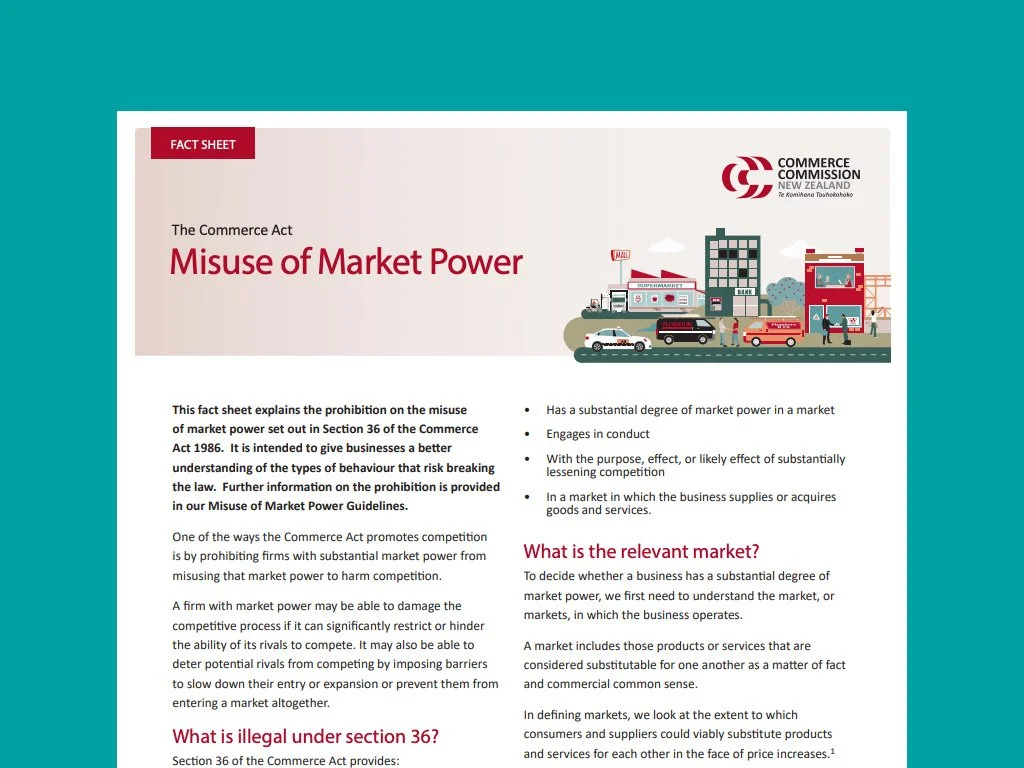
Misuse of Market Power Resources


Get in touch today
Anna Ryan is a specialist NZ competition barrister delivering expert advice and advocacy in competition, consumer and commercial law.